• Skip to main content
  • Skip to primary sidebar

Dr. Steven Davis

Davis Cosmetic Plastic Surgery

  • Home
  • About
    • Meet Dr. Davis
    • What Our Patients Say
    • FAQ
  • Procedures
    • Face Procedures
    • Breast Procedures
    • Body Procedures
    • HALO
    • Coolsculpting
    • Skin Procedures
    • Male Procedures
  • From Dr. Davis
    • Articles
    • Podcasts
      • The Plastic Surgery Revolution
      • Dr. Davis Video Series
    • Media
      • Dr. Davis Video Series
      • In The Media
      • Television Appearances
      • Dr. Davis on the Radio
      • Davis CPS In The News
      • Print Articles / Publications
  • Photos
  • Shop
  • Contact
    • Cherry Hill, NJ Location
    • Northfield, NJ Location
    • Philadephia, PA Location
  • 856-424-1700

Cosmetic Plastic Surgery Articles

What’s the Difference Between Cosmetic and Reconstructive Surgery?

January 11, 2019 by Davis

Cosmetic surgery and reconstructive surgery—and plastic surgery, for that matter—are often used interchangeably, but they shouldn’t be. So let’s clear up the confusion here and now.

Reconstructive surgery is performed to restore function and a normal appearance and correct deformities caused by birth defects, developmental abnormalities, trauma, or medical conditions, including cancer. In fact, breast reconstruction surgery following a mastectomy is perhaps one of the most widely known kinds of reconstructive surgery being done today.

Generally, reconstructive surgery is considered medically necessary, so it’s covered by most health insurance plans, although coverage for specific procedures and levels of coverage may vary greatly depending on the plan.

Cosmetic surgery is performed to enhance appearance, usually by reshaping and adjusting normal parts of the body to make them more visually appealing. Think breast augmentation, liposuction, and tummy tuck. Cosmetic surgery is not considered medically necessary, so it’s not usually covered by health insurance.

Plastic surgery is essentially the field that encompasses both. You can think of cosmetic and reconstructive surgery as sub-specialties of plastic surgery.

Easy as they are to define here, there are some instances when cosmetic and reconstructive surgery overlap and prompt some special attention by an insurance provider. They typically involve surgical operations that may be considered cosmetic or reconstructive, depending on the patient’s situation.

Rhinoplasty, or nose surgery, is a classic example. It’s done a lot of times purely to enhance the appearance of the nose, but it may also be required to restore normal breathing through the nose and normal appearance after a bad nasal fracture.

Also, no matter the type of plastic surgery, the end goal is always to create the best possible cosmetic result.

What to look for in a plastic surgeon
There are no residency programs that focus specifically on cosmetic surgery, so physicians pursuing cosmetic surgery can have varied backgrounds that include medical school and a residency and/or fellowship program, typically in a surgical specialty, which is usually followed by attaining board certification in that specialty and post-residency training specifically in cosmetic surgery.

That said, there’s nothing to prevent a physician from opening a cosmetic surgery practice without having completed formal plastic surgery training in an accredited program. Though, physicians with significant experience in cosmetic surgery can become certified by the American Board of Cosmetic Surgery.

A plastic surgeon, by contrast, completes a residency specifically for plastic and reconstructive surgery and is required to be board-certified by the American Board of Plastic Surgery before beginning to practice.

The American Medical Association recommends choosing a physician based on their training, education, experience, and demonstrated practice history. Ultimately, though, experience and expertise in the procedure you plan to have should be your foremost consideration.

Filed Under: Articles

Welcome to a More Personalized Generation of Breast Augmentation

January 9, 2019 by Davis

Breast augmentation and enhancements are by far the most popular cosmetic plastic surgery procedure performed today. In 2017 alone, over 300,000 breast augmentations and more than 105,000 breast lifts were performed in the United States, according to the American Society of Plastic Surgeons.

Much of the reason that interest continues to grow year after year is because the procedures have evolved. These aren’t the breast implants that first entered the mainstream during the “Baywatch” era. Today’s implants come in a wide range of shapes, diameters, and projections that allows for a much more natural look.

Your augmentation would begin with a series of measurements that, one, ensure the ideal placement of the breasts in relation to your shoulders and, two, properly align the areolas and nipples. It’s a process I’ve come to refer to as Cup Crafting.

Boob Job

During this initial consultation, I’ll also ask you to describe how your ideal breasts would look: perkier, for instance, or fuller. Perhaps, simply, more youthful. This is the time, too, for us to address any questions or hesitations you may have about the procedure:

  • Are there risks for future breastfeeding or mammograms?
  • Will I need help at home after the surgery?
  • Are revisions possible?
  • What’s the cost of that surgery?

We won’t proceed until you’re fully confident in the procedure.

What to expect during the procedure
As for the procedure itself, this is what to expect: The surgery is usually done with either general anesthesia or conscious sedation, so you’ll either be asleep or sedated. It varies by patient, so we’ll discuss it beforehand.

During the surgery, I’ll make small, economic incisions to create a pocket to make room for the implant. Once I’ve positioned the implant, I’ll close and bandage the incisions. The entire procedure usually lasts less than two hours, and you’ll be able to go home soon afterward.

I practice conservation when making any incision, which reduces downtime and post-operative pain as much as possible.

What to expect after the procedure
Recovery varies from one patient to the next, but, on average, full recovery ranges from four to six weeks. You should feel significantly better within a week, though you’ll still want to stick to light activity and avoid strenuous activity until you’re fully healed.

Should you need pain medications after the surgery, you’ll have access to them in accordance with your overall recovery plan.

The incisions will leave minimal scars, but they heal very well and become harder to see with time. Plus, they’ll be located in an inconspicuous spot, so you likely wouldn’t notice them unless you looked for them.

It’s important to enter into a breast augmentation procedure with realistic expectations, and we’ll discuss them during your initial consultation, but this type of breast enhancement can:

  • Improve the fullness of the breasts
  • Improve asymmetry
  • Increase the projection, size, and shape of the breasts
  • Create a more balanced hip-to-breast ratio

Augmentation does have some limitations. In the case of severe drooping or sagging, many women will also need a supplementary breast lift, which can easily be performed alongside the augmentation, diminishing downtime and post-op discomfort.

How long will your results last?
Your breast implants should continue to please for about 15 to 20 years. Sometimes, significant weight gain or loss can affect their appearance, or the implant may shift or cause complications, requiring revision surgery. But I take a meticulous approach that results in an extremely low risk of the implant rupturing or migrating.

Not only are implants much more individualized than they once were, they’re also much safer. So feel confident in both your decision and the results.

Filed Under: Articles

Freeze Your Fat? CoolSculpting is Gaining Popularity

January 8, 2019 by Davis

CoolsculptingCoolSculpting specialists at Davis Cosmetic Plastic Surgery that has practices in Philadelphia, Cherry Hill and Northfield, says CoolSculpting is gaining popularity because it targets many people and is gender neutral. In fact, 40 percent of her clients are male.

“CoolSculpting can have a tremendous result for self-esteem,” she says. “The ideal candidate for this procedure has a normal body weight index but may have a stubborn pocket of fat that won’t go away, like a belly for women who have had children. It can be frustrating to go to the gym regularly and eat healthy but not see any progress. CoolSculpting can give people confidence and they can see a difference that helps them get back on track with their health goals.”

[Original Article Posted www.courierpostonline.com and can be read in its entirety: Freeze Your Fat? CoolSculpting is Gaining Popularity]

Cool Sculpting costs about $750 per applicator, but price does vary depending on the area, says Arnold. And she agrees that the better shape a patient is in to start the better Cool Sculpting works.

“It is best to have patients that eat well and exercise,” says Arnold. “If you continue a healthy lifestyle after receiving Cool Sculpting, the results will stay fantastic.”

Filed Under: Press

Two Different Approaches to Remove Unwanted Fat

January 5, 2019 by Davis

It’s a new year, which means, for most of us, new expectations for ourselves. If living a healthier life is one of your goals, we can help with that.

Eating a balanced diet and exercising on the regular are the surest means to achieve and sustain the healthiest version of ourselves, but the physical results don’t always come as quickly as they feel like they should, which can eventually become our biggest deterrent.

Instead of heading down the same path this year, why not hit the ground running, so to speak, by supplementing your lifestyle changes with a cosmetic procedure that will remove that pesky, unwanted fat, and better position you to succeed? Here are two distinctly different options for your consideration.

The lowdown on liposuction
When you think fat removal and cosmetic procedure, liposuction’s likely the first thought to spring to mind, right? You probably even know someone who’s had it done, it’s that widespread. What is it, exactly? There are a few different techniques, though they all use a thin tube connected to a vacuum to suction fat from the body.

Tumescent liposuction is what you’re probably familiar with. It’s the most common technique. Basically, I inject a sterile solution into the area where I’ll be removing the fat, which makes it easier to suction the fat with less blood-loss and pain.

Depending on the extent of the surgery, you’ll be under either a general or a local anesthesia. And, in most cases, you’ll be going home the same day. That said, you should expect some bruising, swelling, and soreness for a few weeks. It shouldn’t be so much, however, that it keeps you on the sidelines for longer than a few days. You should be able to return to work the following week and be back to doing all your normal activities within a couple weeks.

Liposuction is a viable solution for removing unwanted fat from pretty much any area of your body—the thighs; the abdomen and waist; the inner knee; the cheeks, chin, and neck—but it is not a treatment for cellulite or loose skin.

The question I’m asked all the time about liposuction is: Is it permanent? The fat cells are permanently removed, but the procedure will not prevent you from gaining the weight back with new fat cells. Which is why liposuction should supplement other lifestyle changes.

Liposuction

It doesn’t get any easier than CoolSculpting
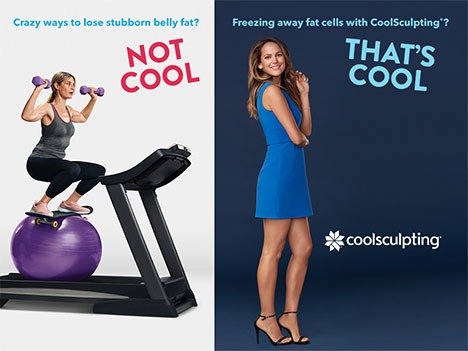
CoolSculpting is a lot less invasive, and it requires little to no recovery, but it is more of a gradual process. It’s an innovative procedure that uses controlled freezing to eliminate unwanted fat.

Years back, a couple of Harvard scientists noticed that some kids got dimples in their cheeks when they ate popsicles. They later came to realize that the popsicles were freezing and eliminating small pockets of fat cells. Simplistic as that sounds, that’s the premise behind CoolSculpting.

The procedure delivers precisely controlled cooling to a targeted area. The treated fat cells are frozen, then die. There’s no damage to the skin or the surrounding tissue. Over time, your body will naturally process the fat and eliminate the dead cells, leaving a more sculpted you.

You won’t be put under. In fact, you can catch up on emails while you undergo the treatment. Even better, you can return to your normal lifestyle as soon as you leave our office.

CoolSculpting

Some may see their desired results after as little as one treatment, but most usually need to undergo a few. Otherwise, it’s pretty much fat-loss on your terms.

Filed Under: Articles

  • « Go to Previous Page
  • Page 1
  • Interim pages omitted …
  • Page 160
  • Page 161
  • Page 162
  • Page 163
  • Page 164
  • Interim pages omitted …
  • Page 191
  • Go to Next Page »

Primary Sidebar

SCHEDULE CONSULT

Follow Us

Contact Us

  • This field is for validation purposes and should be left unchanged.

Our Locations

Cherry Hill
1916 Marlton Pike East
Cherry Hill, NJ 08003
856.424.1700

Philadelphia
1546 Packer Ave.
Philadelphia, PA 19145
215-334-9900

Northfield
2306 New Rd (Rt. 9)
Northfield, NJ 08225
609-653-0500

© 2026 · Davis Cosmetic Plastic Surgery • Privacy Policy • New Jersey Web Design by Trinity Web Media